Browsing Tag

Social Media Strategy

Social Media Strategy

How Does Social Media Affect Elections?

December 1, 2009

Today is a big day in Atlanta politics, and I thought it would be appropriate to revisit the topic of social media’s role in politics.  I won’t be getting into the candidates or my affiliation here, but the issue that I want to discuss is how important it is to use all the tools that are available to engage people through the channels they are already using.

VoteLast year, I wrote a post titled ‘Is This the Facebook and YouTube Election?‘ where I mentioned that Facebook and YouTube changed the dynamics of the Presidential election of 2008 in a profound manner.  Many more people were engaged in the process than ever before, and there was an outlet to connect with people in a way that we had never seen in the political process.  The Atlanta Mayoral race reminds me of that dynamic, and perhaps there is even MORE engagement this time.  I find this to be remarkable because local politics rarely gets this kind of attention.  Sure, people get fired up during a Presidential election, but the city level races are rarely in the limelight in this way.

What we’re seeing in the Atlanta race is a willingness to discuss the issues that the community is passionate about, and there has been a great deal of back and forth about the merits of the individual candidates in social channels.  Interestingly, in my conversations with friends, neighbors, etc., very few of those that I’ve spoken with have actually watched the candidates debate on TV.  There have been several televised debates, but many people are simply not tuning in.  But these same people are on Facebook constantly and are engaged in wall posts, video posts, etc. that relate to the race.  There have been several threads that I’ve participated in that have significant engagement with people that I know, and people that I’ve never met before.  Great information is being spread, and hopefully it’s helping people in their decision in the voting booth.  Many people have said they are on the fence, and I can’t think of a better way to get them off the fence than engaging them directly with information and opinions through a trusted friend network on Facebook.

There’s a lesson in this for brands.  People are engaging with each other in these spaces and for many of them it’s the primary way they engage with brands.  In this example, the political candidates are each their own brand, and it will be particularly interesting to see how the candidates use of social media factors into the results of the election.  It’s an incredibly tight race, and they are both doing what they can to get their supporters out to the polls.  There is a difference however – one has a much more robust following on Twitter and Facebook, while the other one is a relative newcomer to the scene.  There was a similar dynamic during the Presidential election last year.  I’m very interested to see if the same pattern holds this time around.

What lessons do you take from this?  Have you been a part of a political discussion through social media that would never have happened otherwise?  How do you think social media affects elections?

Social Media Strategy

Is Being Unreasonable A Good Strategy?

November 30, 2009

UnreasonableI was talking with a good friend last night about ‘the state of things.’  We tend to veer off into lofty conversations on issues that matter to us, and it’s often quite productive for me.  Last night was one of those nights.  While we talked, I remembered a program I ran across called the Unreasonable Institute – they are looking for 25 of the world’s most outrageous minds to encourage and enable to do great things.  The question that came to mind was – do we have to create things that are ‘unreasonable’ to get noticed or attract attention?  Has the status quo stifled our thinking to the point that we have to go far outside the norm to capture the imagination of our audience? I suspect this might indeed be the case.

It seems more and more non-traditional thinking is breaking through in all segments of society – in business, in government, in development, etc.  The fact that this is being celebrated is encouraging and reinforces that we’re actually in a very transformative period right now.

Last night as we talked about some of the opportunities on the horizon, I shared that I recently read a book my cousin Whitney gave me to check out called The City in 2050 published by the Urban Land Institute.  Pretty incredible stuff here – I highly recommend you read it if you are interested in urban planning, architecture, future development and related topics.  The book highlights some very thought provoking insights into a likely urban model for the future.

While we were talking, I Googled the initiative on my iPhone and jumped over to the ‘2050’ page to see how well they were connecting.  What I saw was an incredible opportunity to spread this message much further than it’s being spread right now.  The opportunity that jumped out at me was under the ‘Enter the Dialogue’ section.  If you click on the Creating Blueprints – Enter the dialogue link, it takes you to a page with a paragraph and an email address.  Most of us in the social media space would agree that an email link does not typically qualify for encouraging dialogue, thus the opportunity!  To be fair, ULI does have general links to Facebook, Twitter, YouTube, and LinkedIn from their home page.

Perhaps identifying initiatives like this one that are well established but lack a thorough engagement strategy and helping them connect with key audiences through social channels is a business model in and of itself.  Could working with ULI and other non-profits to help spread the word about initiatives that matter to the world without a pure profit motive be considered unreasonable?  I bet most people would say it is.  I wonder what the Unreasonable Institute would say?

What do you think?  Is being unreasonable a good strategy?  If so, what are some of the unreasonable ideas that you have for yourself or your business?  Do you find this kind of thinking is encouraged or discouraged in your organization?

By the way, if you are interested in applying to the Unreasonable Institute, you better hurry – the clock is ticking! 14 days and counting until applications are due.

Photo credit: iStockPhoto

Social Media Strategy

What Do Consumers Really Want from Brands in Social Media?

November 9, 2009

Important

Razorfish has just come out with their very smart FEED report that digs into behavior of ‘connected consumers,’ which are the ones that most of us are trying to reach with our online and social campaigns.  The report goes into detail about what these connected consumers are doing and how they are engaging online.  The statistics are pretty amazing, although not altogether surprising (to me at least).

According to the report:

“Based on our 2009 Razorfish Digital Brand Experience Study, 65% of consumers report having had a digital experience that either positively or negatively changed their opinion about a brand. Of that group, a nearly unanimous 97% say that their digital experience influenced whether or not they eventually purchased a product or service from that brand.”

This is pretty straightforward, and should definitely grab some marketers’ attentions.  I certainly hope so!

The piece in the report that caught me was that consumers are looking for deals on social media, and they are not necessarily there because they share the brand’s values.  This definitely raises an important point and it’s a good idea to probe a bit on this to figure out how best to capitalize on this insight. Here are a few thoughts on this:

1. Economics. I think it’s worth noting that we are coming out of a recession and naturally consumers are looking for deals online.  I bet this explains some of the info on what people are looking for in social channels.  But beyond just money, people want something unique or different – something that the average consumer isn’t getting.  Of course, the easy thing to do is just offer a discount or some kind of sale.  But there’s more that we can offer to satisfy consumer appetite in social channels. Let’s not throw the baby out with the bath water just yet please.

2. Unique Content. There are other ways to reward consumers for being a friend/fan/follower of a brand outside of the typical discounts or sales.  Interestingly, in the FEED report, Whole Foods was cited as one of the brands that is ‘getting it’ and offering info on weekly specials AND shopping tips.  The latter is something that probably costs them very little, but helps customers have a better shopping experience with Whole Foods.  Is this valuable?  You bet it is.  This is getting more into the mind of the customer and really helping them outside of just financial rewards (discounts).

3. Advance Info. Social channels give us the ability to make announcements quickly, and give fans, followers, friends, etc. a ‘heads up’ that something big is happening.  Making big announcements via social channels is a great way to reward these fans that make public proclamations of their brand support.  And of course, the mix of communications is important here.  We don’t want to fall into the trap of only pushing out messages that we want our audience to respond to, but those messages should be peppered in along with other messages that are truly useful to the community.

4. Limited Editions. Nothing groundbreaking here, but this is a concept that can be utilized in social channels to keep fans happy.  If there is a limited edition item that can be announced and made available through exclusively social channels, then this can be used as a thank you to the members of the community.  This not only rewards the community, but it encourages the viral effect, because those who don’t have access to the limited edition item will no doubt want to know why.  When they find out, it’s a good bet that they will join the community so they are in the know the next time around.

5.  Special Events. Inviting fans to a special event is another easy way to show appreciation and reward them for sticking around.  Another old-school tactic, but one that translates well into social channels.  How easy is it to send out an invite to an event via social media?  Pretty easy.  Is this something that the community would value?  Probably so.  This one may cost some money, depending on what the event is, but the potential upside may be worth the investment if done properly.

These are just a few thoughts that come to mind after reading the FEED report.  I certainly think that providing deals and discounts is a strong proposition for many brands, particularly in the current economic climate, but this isn’t the only way to generate loyalty in social media.  In the end, it’s not about the channel – it’s about Marketing.  Some things don’t change just because there is better technology and more communication channels we can use.  Sometimes you have to get back to the basics and figure out creative ways to connect with your audience without falling back on price cuts or sales.

Download the full FEED report here.

Special thanks to @gschmitt and the Razorfish crew for this outstanding report.  It’s a must-read for any marketer.  Give it a read and I’d love to hear your take on what this means for brands.

Social Media Strategy

Consumer Insights and ROI

September 2, 2009

BestBuy

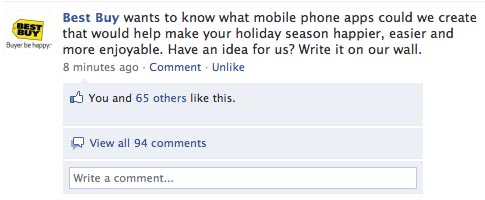
The other night while on Facebook, I saw this post from Best Buy that really stood out to me and reminded me of how much I admire their approach to social media. The post asked for feedback on what types of mobile applications they should create to make the holiday season happier, easier, and more enjoyable for their customers. Wow – what a concept! Not only is this one of the best examples I’ve seen of intelligent engagement of the community, but also it promotes the exploration of another smart medium for many brands – mobile.  Despite a lot of the comments being ‘noise,’ there were definitely some nuggets in there that had my head nodding. Here are just a few of the comments (unedited) that I think provide some decent insights:

“An app that downloads specials while in store — good for that visit — reward people that actually make it in to the store”

“Weekly bargins, open box items for fav stores, ability to look up warranty info from serial #, store locator / phone”

“an app that connects people’s whishlists so you can see what the people you know whant for christmas that alow that person to search the facts on that item”

“App idea (not just for holiday season)…
-definately like the sales flyer app
-toss in some stock checking functionality via GPS feature (grabs local zip code via GPS and shows if an item is in stock for closest store).
-Random item… click button -> app displays a random item.
…just a thought.”

“An app that has current specials and local store specials, including unadvertised ones. Also push notifications when a particular product falls below a set price would be nice too.”

“How about a video game app so that when people are doing their holiday shopping the kids can look through the digital catalog and pick out something they like so then the mom/dad will know what they want. please, dont make it just for iphone/ipod. some people have blackberries”

This got me thinking – how do these insights factor into the ROI of their Facebook program? They can obviously measure the number of comments and ‘likes’, and they can also look at the number of ‘good’ ideas that came out of it. Then there’s the ratio of quality comments to overall comments. None of these metrics track directly to the bottom line, but there is a value in this type of engagement to be sure. This type of immediate feedback on a question from a brand is unprecedented with traditional channels, which is a key differentiator for social media. Surely this must have value, but how would you begin to assign a number to it or calculate the true ROI?

It will be interesting to see how Best Buy responds to the input they have received from the community on this initiative. With such a wealth of input, they should be able to create a home run for their customers. I’ll be looking for the app over the next couple of months to see where they landed.

As a side note, I started this post before lunch when Best Buy had about 496,000 fans. As of this writing, they are over 505,000. That’s incredible growth in just a few hours!

Social Media Strategy

The 60% of ‘Non-Pointless Babble’ on Twitter

August 21, 2009

BabbleA recent study conducted by Pear Analytics raises some interesting questions on the opportunities for brands and marketers on Twitter.  Of course, many of the subsequent articles have focused on the 40% of ‘Pointless babble’ that was the highest scoring answer.  Let’s be honest – it would appear on the surface that the survey selections were skewed to show Twitter as an unfavorable medium for marketing with ‘Pointless babble’ being a choice in the survey.  Wouldn’t a more neutral choice such as ‘General chatter’ or something that is less biased have been more appropriate?

Either way, that still leaves the other 60% of tweets that have potential value for marketers.  For example, the second highest scoring selection was ‘Conversational’ with 37%.  If we are doing our jobs as marketers in social media, isn’t this really the sweet spot we should be focusing on?  Throw in the ‘Pass along value’ and ‘News’ tweets, and you have what is arguably a substantial volume of activity that has potential to provide value to marketers and consumers.  I think the glass if half full here.  Babble or no babble, there is real opportunity for those who choose to tune in and participate.

If another report came out tomorrow that concluded that a low percentage of people used TV for ‘Watching dumb commercials’, should we call into question the effectiveness of advertising on TV?  Of course not. Perhaps this is just a case of people not understanding how to filter out the noise and benefit from the dialogue on Twitter.  Email spam is a big issue too, but most people haven’t stopped using email to communicate.  There is no reason to throw the baby out with the bath water here.  We can choose to ignore the babble and focus on the real value that lies in the conversation.