Browsing Category

Social Media Strategy

Social Media Strategy

Where are you engaging your audience?

October 30, 2009

Earlier this week I ran across a post that smartly drew a metaphor between marketing to consumers and ‘finding the kitchen’ at a party. You probably know the drill – people gravitate to the kitchen during parties, no matter how much you try to migrate the group to other areas. This is an outstanding metaphor for brands who want to connect with people on the web (or anywhere for that matter).Listen

I recall sitting down at an impromptu meeting last year where I was the lone ‘social media guy’ presenting on the fly to a room full of entertainment biz execs and marketers. The conversation drifted to ‘we need to drive traffic to our website,’ to which I paused and asked the question ‘what is the ultimate goal of interacting with this audience?’ See, web traffic should not be the goal – sales should! In other words, who cares how many people come to your website if they don’t buy anything (or do something else you’re hoping they will do for you)? When I posed the question, I got a lot of blank looks and a couple of people talking about how they ‘needed’ web traffic for this or that, but there was no compelling rationale for not providing content and engaging with the audience via social media vs. the websites they had created for their artists. Basically they were lukewarm to the idea of engaging with their audience too much on social platforms unless we were specifically driving them back to their sites (to consume essentially the same content). By holding back, they forgot where the kitchen was.

The above example is no doubt played out again and again on the social web day after day. We’ve all seen it – Facebook posts or tweets that are essentially only recycled sound bytes from ads, promotional offers, etc. Come to our website, buy our stuff, talk about us, etc., etc. To return to the kitchen metaphor, why not just hang out in the kitchen, wherever that might be? In other words, if the target audience is on Facebook, engage with them there! If they are communicating on targeted blogs or forums, find a way to add value to those conversations. Our job as marketers is to make the cash register ring, regardless of whether or not we run up web visits to any specific site.

Of course not everyone will end up hanging out in the kitchen – they might like the basement game room more, or perhaps the back yard, or the deck. The point is, let them decide where they are most comfortable hanging out, and join them there. Maybe the kitchen is Facebook, the game room is Twitter, the back yard is the mobile web. If you have a broad audience, you’ll have different places to pay attention to. Just like a party is more fun when you let people hang out where they want, you’ll encounter less resistance if you engage your audience on their terms, in their space. Just make sure you’re a good host. Nobody likes a lame party.

Definitely check out the post by Kaila Colbin that inspired this post and reminded me of that meeting last year. You can also connect with Kaila on Twitter here.

Social Media Strategy

Is There a Secret to Mobile Engagement?

October 15, 2009

CellphoneThis morning I was reading an AdAge article that highlighted an agency’s findings on female engagement with mobile web advertising on iPhone compared to other devices.  The overall finding was that women with iPhones were much less engaged after clicking through from a mobile ad.  The question that popped into my head was – why?  Why was the engagement so much lower?  Are these consumers really that disinterested, or is there something else going on? Conspicuously absent was any mention of conversions, sales, or other form of ROI.  In other words, what were the non-iPhone users doing while they were so much more engaged?  Did that engagement translate into measurable ROI for the brands?

The article went on to describe the rationale for how some big brands opt for a one-size-fits-all mobile site for their mobile initiatives in an effort to maximize reach (and presumably minimize cost).  I can’t help but wonder if this approach is always the most effective in the long run.  Of course, to get to the bottom of what is really going on with this group, you’d have to dig a lot deeper, but let’s consider a couple of topics that should be addressed before brands jump into a mobile initiative:

Knowing the audience first
Who are you targeting?  If the answer is ‘everyone’ or ‘women 19-49’, that’s the first problem.  In traditional media, brands probably wouldn’t run the same ad when targeting a 20 year urban college student as they would a 45 year old mom from rural Indiana.  Why should mobile be any different?  And I’m not just talking about the ad creative – I’m talking about the way mobile campaign is designed.  More on that below.  Slice and dice your audience into manageable segments and determine what platforms/devices are common in each segment so that your mobile campaigns can be more effectively targeted.

What tactics should you employ?
Keeping the above in mind, does it make sense to focus your resources on building out a single mobile site that can be accessed from most mobile devices, or is it potentially more effective to develop custom applications for multiple mobile platforms?  Should you run an SMS campaign or purchase mobile banner ads?  What about sponsoring existing mobile apps?

These are not black and white questions, and in my opinion cannot be answered easily.  These questions brings up many others: What do your targets need and how can you help them? How many of them are there on a given platform (iPhone, Blackberry, traditional web-enabled mobile phone, etc.). Can you provide a solution to them on-the-go that benefits them and increases sales, conversions, viral spread, etc.?  Perhaps a targeted app that provides a mix of utility and entertainment will have a higher conversion rate than a banner ad that clicks through to a mobile site for a portion of your audience. Maybe an SMS campaign that allows you to send product info or discounts to consumers at the point of purchase will be most effective with a specific segment. The point is that one size does not fit all, and a thorough understanding of the audiences and opportunities to engage each segment is necessary before embarking on a mobile initiative.

Reach vs. Value
Historically, advertising has been measured by how many people saw the ad, or the Reach.  Now, there are other metrics to consider and the Value of the resulting engagement is much more important to measure.  Does it really matter how many people click on your ads or visit your mobile site if they don’t make a purchase or otherwise move the needle that your company is trying to move?  Isn’t is just as effective to reach less people but have a higher rate of conversion?  The Value of the interactions is vital.  The rest is just window dressing for corporate reports.  Value can be measured in a myriad of ways – requests for additional info, forwarding, tweeting, posting to Facebook, click through to purchase, up-selling, etc.  Depending on the goals, the way Value is measured will vary.

If you are planning a mobile initiative, the topics above are a starting point.  What are some others that come to mind for you?  Do you think there is a secret to mobile engagement?  I look forward to the comments.

Social Media Strategy

Consumer Insights and ROI

September 2, 2009

BestBuy

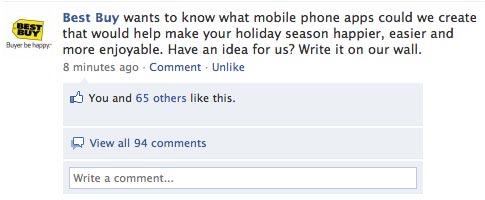
The other night while on Facebook, I saw this post from Best Buy that really stood out to me and reminded me of how much I admire their approach to social media. The post asked for feedback on what types of mobile applications they should create to make the holiday season happier, easier, and more enjoyable for their customers. Wow – what a concept! Not only is this one of the best examples I’ve seen of intelligent engagement of the community, but also it promotes the exploration of another smart medium for many brands – mobile.  Despite a lot of the comments being ‘noise,’ there were definitely some nuggets in there that had my head nodding. Here are just a few of the comments (unedited) that I think provide some decent insights:

“An app that downloads specials while in store — good for that visit — reward people that actually make it in to the store”

“Weekly bargins, open box items for fav stores, ability to look up warranty info from serial #, store locator / phone”

“an app that connects people’s whishlists so you can see what the people you know whant for christmas that alow that person to search the facts on that item”

“App idea (not just for holiday season)…
-definately like the sales flyer app
-toss in some stock checking functionality via GPS feature (grabs local zip code via GPS and shows if an item is in stock for closest store).
-Random item… click button -> app displays a random item.
…just a thought.”

“An app that has current specials and local store specials, including unadvertised ones. Also push notifications when a particular product falls below a set price would be nice too.”

“How about a video game app so that when people are doing their holiday shopping the kids can look through the digital catalog and pick out something they like so then the mom/dad will know what they want. please, dont make it just for iphone/ipod. some people have blackberries”

This got me thinking – how do these insights factor into the ROI of their Facebook program? They can obviously measure the number of comments and ‘likes’, and they can also look at the number of ‘good’ ideas that came out of it. Then there’s the ratio of quality comments to overall comments. None of these metrics track directly to the bottom line, but there is a value in this type of engagement to be sure. This type of immediate feedback on a question from a brand is unprecedented with traditional channels, which is a key differentiator for social media. Surely this must have value, but how would you begin to assign a number to it or calculate the true ROI?

It will be interesting to see how Best Buy responds to the input they have received from the community on this initiative. With such a wealth of input, they should be able to create a home run for their customers. I’ll be looking for the app over the next couple of months to see where they landed.

As a side note, I started this post before lunch when Best Buy had about 496,000 fans. As of this writing, they are over 505,000. That’s incredible growth in just a few hours!

Social Media Strategy

The 60% of 'Non-Pointless Babble' on Twitter

August 21, 2009

BabbleA recent study conducted by Pear Analytics raises some interesting questions on the opportunities for brands and marketers on Twitter.  Of course, many of the subsequent articles have focused on the 40% of ‘Pointless babble’ that was the highest scoring answer.  Let’s be honest – it would appear on the surface that the survey selections were skewed to show Twitter as an unfavorable medium for marketing with ‘Pointless babble’ being a choice in the survey.  Wouldn’t a more neutral choice such as ‘General chatter’ or something that is less biased have been more appropriate?

Either way, that still leaves the other 60% of tweets that have potential value for marketers.  For example, the second highest scoring selection was ‘Conversational’ with 37%.  If we are doing our jobs as marketers in social media, isn’t this really the sweet spot we should be focusing on?  Throw in the ‘Pass along value’ and ‘News’ tweets, and you have what is arguably a substantial volume of activity that has potential to provide value to marketers and consumers.  I think the glass if half full here.  Babble or no babble, there is real opportunity for those who choose to tune in and participate.

If another report came out tomorrow that concluded that a low percentage of people used TV for ‘Watching dumb commercials’, should we call into question the effectiveness of advertising on TV?  Of course not. Perhaps this is just a case of people not understanding how to filter out the noise and benefit from the dialogue on Twitter.  Email spam is a big issue too, but most people haven’t stopped using email to communicate.  There is no reason to throw the baby out with the bath water here.  We can choose to ignore the babble and focus on the real value that lies in the conversation.

Social Media Strategy

The 60% of ‘Non-Pointless Babble’ on Twitter

August 21, 2009

BabbleA recent study conducted by Pear Analytics raises some interesting questions on the opportunities for brands and marketers on Twitter.  Of course, many of the subsequent articles have focused on the 40% of ‘Pointless babble’ that was the highest scoring answer.  Let’s be honest – it would appear on the surface that the survey selections were skewed to show Twitter as an unfavorable medium for marketing with ‘Pointless babble’ being a choice in the survey.  Wouldn’t a more neutral choice such as ‘General chatter’ or something that is less biased have been more appropriate?

Either way, that still leaves the other 60% of tweets that have potential value for marketers.  For example, the second highest scoring selection was ‘Conversational’ with 37%.  If we are doing our jobs as marketers in social media, isn’t this really the sweet spot we should be focusing on?  Throw in the ‘Pass along value’ and ‘News’ tweets, and you have what is arguably a substantial volume of activity that has potential to provide value to marketers and consumers.  I think the glass if half full here.  Babble or no babble, there is real opportunity for those who choose to tune in and participate.

If another report came out tomorrow that concluded that a low percentage of people used TV for ‘Watching dumb commercials’, should we call into question the effectiveness of advertising on TV?  Of course not. Perhaps this is just a case of people not understanding how to filter out the noise and benefit from the dialogue on Twitter.  Email spam is a big issue too, but most people haven’t stopped using email to communicate.  There is no reason to throw the baby out with the bath water here.  We can choose to ignore the babble and focus on the real value that lies in the conversation.